Peculiar Julia - Thought repository and wine-fuelled rambles, digital scrapbook and general shambles
Menu
Skip to content
  • home
  • About me/contact
  • planning
  • creativity
  • crafty stuff

Month: July 2009

Oof — melting and puddling from stomach-churning desire

22 July, 2009


Anais Nin loved Henry Miller utterly. Completely. In him she found her equal in mind. She was consumed by him emotionally, physically, sensually (and he with her). I read what she writes about him, about her love for him; his letters to her, and I warm up and puddle and melt from desire and yearning, an inexorable and hot longing.

This is what I seek. I thought I had found the connection of mind and spirit in someone I had met, the possibility for a true meeting of souls in a deep, deep connecting way … intellectually, spiritually, emotionally, AND sensually, but not so after all. I had started to think it was all a cruel delusion, wanting that sort of connection, that it was not humanly possible, an impossible dream none of us can ever reach. But to read these passages… I see it is possible.

“Later, a small dark room, so shabby, like a deep-set alcove. Immediately, the richness of Henry’s voice and mouth. The feeling of sinking into warm blood. And, overcome with my warmth and moisture. Slow penetration, with pauses and twists, making me gasp with pleasure. I have no words for it; it is all new to me. …

“My hunger is not abnormal. With Henry I am content. We come to a climax, we talk, we eat and drink, and before I leave he floods me again. I have never known such plenitude. It is no longer Henry; and I am just woman. I lose the sense of separate beings. …

I am humble before my giant Henry. And he is humble before me. “You see, Anais, I have never before loved a woman with a mind. All the other women were inferior to me. I consider you my equal.” And he, too, seems to be full of a great joy, a joy he has not known with June. “

“That last afternoon in Henry’s hotel room was for me like a white-hot furnace. Before, I had only white heat of the mind and of the imagination; now it is of the blood. Sacred completeness. I come out dazed in the mellow spring evening and I think, now I would not mind dying. Henry has aroused my real instincts, so that I am no longer ill-at-ease, famished, incongruous in my world. I have found where I fit. I love him, and yet I am not blind to the elements in us which clash and out of which, later, will spring our divorce. I can only feel the now. The now is so rich and so tremendous…

“I meet Henry in the gray station, with an instantaneous rising of my blood, and recognize the same feelings in him. He tells me he could hardly walk to the station because he was crippled with his desire of me…

“And here I stumble, because of inexperience, dazed by the intensity and savagery of those hours. I only remember Henry’s voraciousness, his energy, his discovery of my buttocks, which he finds beautiful–and oh, the flowing of the honey, the paroxysms of joy, hours and hours of coition. Equality! The depths I craved, the darkness, the finality, the absolution. The core of my being is touched by a body which overpowers mine, inundates mine, which twists its flamed tongue inside of me with such power. He cries, “Tell me, tell me what you feel.” And I cannot. There is blood in my eyes, in my head. Words are drowned. I want to scream savagely, wordlessly–inarticulate cries, without sense, from the most primitive basis of my self, gushing from my womb like the honey. Tearful joy, which leaves me wordless, conquered, silenced. God, I have known such a day, such hours of female submission, such a gift of myself there can be nothing left to give. But I lie. I embellish. My words are not deep enough, not savage enough. They disguise, they conceal. I will not rest until I have told of my descent into a sensuality which was as dark, as magnificent, as wild, as my moments of mystic creation have been dazzling, ecstatic, exalted.”

“He sleeps in my arms, we are welded, his penis still in me. It is a moment of real peace, a moment of security. I open my eyes, but I do not think. One of my hands is on his gray hair. The other hand is spread around his leg.”

Not once in my (now becoming long!) life. But others have found it, she found it. Where is the person to match me, I wonder? Oh, to have this sensualism bought out in me … the thought makes me swoon, makes waves wash over me … I long so much, desire so much. One day I will choke on it. I wait. For the faceless, unknown man. And hope he actually exists somewhere!

Share this:

  • Email
  • Print
  • Facebook
  • Twitter
  • Pinterest
  • Tumblr
  • More
  • LinkedIn
  • Reddit
  • Pocket

Like this:

Like Loading...
Leave a comment
Share
  • Pin it
  • Share
  • Tweet
  • Share
  • Email
  • Print

A transformative painting experience of an Aboriginal legend

20 July, 200913 July, 2016

This past week, I can safely say, has been one of the best weeks of my life. I have spent it in Sydney, at the International Anthroposophical Art Conference. It was held at “Riverview” (St Ignatius College … a Jesuit school for boys). First lesson of the conference… the Jesuits are richer than God … I kid you not. This place is huge. Acres and acres on prime riverside/harbourside land. The construction of the main building (a HUGE 3 storey affair made of big sandstone blocks) commenced in the 1880s. I will post photos in my albums later.

We had accommodation on the grounds, all lectures were held in the theatrette (just like a big university lecture room), we had concerts of a night time, morning singing sessions, and two painting workshops per day. My workshop was Art in Therapy (using watercolors). We painted based on an old Aboriginal legend, as a transformative story (and process of painting), a metamorphosis, that can be used for people undergoing major life changes and crisis (I found it particularly good on a personal level for me, given last year’s battle with cancer etc). Here I tell the legend, and show you the painting that I did as a result.

The Message of Butterflies

This legend comes from the Barkindji people of northern New South Wales. It is thought-provoking; a legend you will not easily forget. It explains how the very first Barkindji people came to understand and accept death. It explains how they came to an awakening belief in life beyond the grave.

There was a time when the creation of this land was still very, very new; when the birds and animals and all other creatures shared a common language; when humans could interchange their form or personality with that of birds and animals; when the concept of death and dying was still unknown. This was in the early days of the Dreaming. As you might expect, however, a death did eventually occur.

One evening a young cockatoo fell from its nest and lay lifeless on the ground with its neck broken. The first people, together with all the other birds and creatures, were very concerned, and indeed quite frightened. This was something they had no concept of; they did not understand.

A great crowd stood around silently and watched as the humans tried, unsuccessfully, to revive the bird. After a time the Elders of the group decided that the ever-present spirits must have chosen to take the life force from teh cockatoo so that it could be transformed or used in some new way. Still, they were very puzzled by this new occurrence. They agreed that they needed to experiment further.

They called for volunteers. At first no-one at all was keen to die so that the process could be studied by the others, but after a time some lowly caterpillars did, tentatively, offer their services. It was understood that the phenomenon of death, as seen by what had happened to the cockatoo, meant that those creatures involved in the experiment had to reach a stage in which they were totally still. They had to reach a stage in which they did not move, eat, see, hear, or do anything at all. It was agreed that the caterpillars must somehow mesmerize themselves ingto such a state and then maintain it for a period of time, to see what would happen.

A protective cocoon was duly made for each caterpillar. The cocoons were attached to the limbs of the tallest trees, some of which almost reached up to the sky-world. All through the long, cold winter the cocoons hung there in that place. At first the eager people watched them with great anticipation. Bu days and weeks went by and there was no change, no magic transformation, nothing at all to see. The people of course became very disappointed. Meanwhile, they kept themselves very busy making tools, gathering food, learning to build shelters and generally helping each other. Indeed they were so busy that, as the winter months slowly passed, most of them quite forgot about the caterpillars who had crawled into those dark cocoons, so many weeks earlier.

During this beginning period in time, the pattern of the four seasons was also still developing. The people were pleased indeed when, after the long, cold, bleak winter, the earth gradually began to warm up, yet again. They were delighted. It was exciting to see the buds bursting into blossoms; to see the leaves growing again on the bare trees; and most of all to feel the sun becoming warmer and warmer each day.

The people were so pleased that they began planning a feast and a special corroboree of celebration. They wished, through their corroboree, to show their gratitude to their creator for all the joys of the new season which we now know as spring. The celebration feast had just begun when a whole bunch of excited dragonflies swarmed in among the people.

‘Look up. Look up,’ they urged. ‘Look up at the cocoons.  They are splitting open!’

A breathless hush fell upon the crowd as all eyes turned expectantly towards the tall trees. Each person gasped in amazement and wonder as, one after another, the cocoons opened, letting loose a host of beautiful butterflies, the like of which had never been seen before. The delicate creatures fluttered gently down to be admired. They spread their fragile, multi-colored wings, the colors of which shone radiantly, iridescently, in the soft light. They rested gracefully on nearby bushes and trees. They looked splendid.

All the people watched in quiet delight. They were pleased that their experiment had been successful. The dull, ordinary caterpillars had indeed bee magically and wonderfully transformed. It was a most exciting result and the people, after that, lost their fear of death.

After such a demonstration, they would always see the process of death as a stage, as a still and silent stage, prior to a wondrous and exciting transformation, a new beginning.

Now, centuries have passed, and generation after generation of Aboriginal people have been born and have lived out their lives in this area. And all of them, together with most other people from other areas, have continued to hold this belief firmly in their hearts. Their faith has been renewed every spring as yet another cluster of beautiful butterflies has magically emerged.

***************
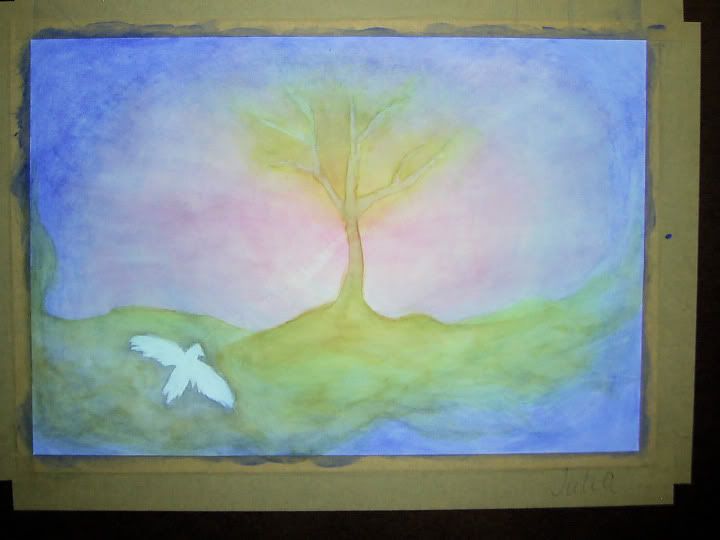
At this stage I decided to take a photo because I was liking it so much and I wanted a record in case I stuffed it up along the track. Good thing I did 🙂

First, we started off ‘breathing in’ a blue, from the edges into the center, ultramine, to cerilean, fading to a white center. This was the beginning of creation. The blue is enfolding, nuturing, surrounding. The aim is to feel this as you paint. Carmine red is introduced into the center breathes out into the blue. The very first evening. The cockatoo is painted in next (we used gouache for this), surrounded by a gray ‘plane’ of death. Next we introduce more blue, strengthening parts of the blue, feeling the fear of the people and other animals. Next we introduced yellow. Yellow is an inquiring color, a color that likes to play and spread. Over the blue of course this produced the green. The tree felt it needed to go in the middle. I needed to keep washing over the cockatoo with color to keep him ‘dead’. He kept resurrecting himself with bright white! More intensification of blue, and violet communicating with the red and blue. Some ochre in the green to give it some ground. And the glow around the tree. More yellow/green.

I was very VERY happy with my painting at this point, considering this is the first time I’ve done a ‘real’ painting as opposed to a couple of color exercises.
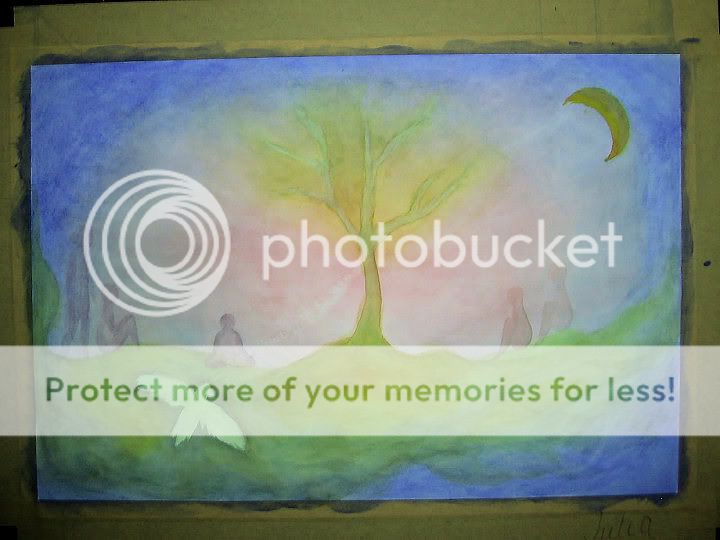
Next the elders were painted in, in incarnadine, and a soft violet. I decided to do most of them sitting, waiting, wondering. At this point came the first of the stuff-ups … that bell-shaped Buddha-like one near the cockatoo. He shouldn’t be there. The more that was added, the more that everything that was already there needed to be strengthened. The green in the tree trunk, more peach blossom, more yellow/green.


The finished product.

The moon is falling away from the earth, separating itself. The cocoons are built in the trees for the volunteers … the catepillars. A time of quiet, waiting, stillness for the volunteers. Then … the butterflies arrive. I have to say right out I do NOT like my butterflies. One is the shape, naturally, and the other is the color. Now, the tutor doing our workshop had me do the butterflies this color because of the way it reacts playfully against the pink in the middle.  All of a sudden it looked like an illustration in a childrens book (which is fine, just not what I wanted, although it DOES make .me think of different things I could do perhaps…) I wanted multicolored butterflies, rather diaphanous butterflies. Not such solid, blue ones. Then, last of all of the new things in the picture, the green around the tree. The ‘leaves’, as it was the very first spring. This took away the beautiful silveryness of the tree bark, covered most of the glow, and came down and touched the biggest butterfly, making the placement all wrong.

So there it is, a story told in the actual ACT of painting, which is to be felt in the soul as you do it. I suppose I have to admit it’s not bad for a very first effort. In fact, I WAS told I had talent and I should definitely keep on painting. Very affirming, very warm and good for the self esteem.

But the best thing … I had FUN. I could stand at that easel for hours (and did), totally absorbed, totally happy, and unaware of anything around me. Only when we were told we had to stop did I notice that my feet hurt badly, or that it was dark outside the classroom and it was time for dinner! I am definitely going to do a lot more painting. It was bliss.

Share this:

  • Email
  • Print
  • Facebook
  • Twitter
  • Pinterest
  • Tumblr
  • More
  • LinkedIn
  • Reddit
  • Pocket

Like this:

Like Loading...
4 Comments
Share
  • Pin it
  • Share
  • Tweet
  • Share
  • Email
  • Print

On Love, Sex and War

11 July, 2009

Anais NinYesterday I finished the second volume of Anaïs Nin’s diary. As luck would have it, yesterday also brought the arrival of Henry and June, Delta of Venus and Eros Unbound (the last two being her erotic short stories … and oh boy, they are erotic!).

I am again utterly enchanted by her. I can see the fascination she held for both men and women. While her narcissism at times is repulsive, I can’t help but be intrigued. That narcissism, though, I’ve seen in other creative ‘geniuses’ that I know, true artists. Maybe it’s a prerequisite.

In Henry and June, though, because it is unabridged and she talks of her husband, and her love for him, Henry and June, and talks about her ecstasies, she becomes to me more of a burning flame. She lives as a woman with vulnerabilities, becomes more real. The letters between her and Henry Miller are so beautiful. He woke her up sexually and sensually. If only we could all be so lucky.

Such a wise woman. She was a healing, intuitive guide with a deep knowledge of what it is to be woman. What I deeply want to be myself. From the second volume, at the outbreak of WWII:

“When you live closely to individual dramas you marvel that we do not have continuous war, knowing what nightmares human beings conceal, what secret obsessions and hidden cruelties.”

…

“You give you faith, your love, your body to someone, year after year, and within this human being lies a self who does not know you, does not understand and is driven by motives even he cannot decipher. In one instant, all that was created between you, every word said in trust, every caress, every link as clear to you as a piece of architecture, an architecture born of feeling, of mutual work, of memories, is swept away by some inner distortion, a twisted vision, a misinterpretation, a myth, a childhood being relived. And this was the madness we were about to enter on a grandiose scale. For war is madness.”

…

I had the illusion that when one loves, just as when we create human children, we create a permanent image of love like an iron statue by a sculptor. I was horrified to discover that the image the other person carried within him bore no resemblance to one’s own, or that it could be annihilated by another love, or by a misunderstanding, or a distortion, or a failure of memory. This gave me a foretaste of death. We were not enshrined in the other’s heart, and the one we loved was often immured, alone, separate from us. The war destroyed our illusion of a strong, unshatterable intimate world of personal loves.

Other passages from the second volume that spoke:

Read More

Share this:

  • Email
  • Print
  • Facebook
  • Twitter
  • Pinterest
  • Tumblr
  • More
  • LinkedIn
  • Reddit
  • Pocket

Like this:

Like Loading...
1 Comment
Share
  • Pin it
  • Share
  • Tweet
  • Share
  • Email
  • Print

The nature of woman

5 July, 2009

Esther Harding (The Way of All Women):

The moon-like character of the woman’s nature appears to men to be dependent only on her whims. If she changes her mind, it never occurs to him that she changes it because of changed conditions within her own psyche, as little under her control perhaps as a change in the weather … Woman’s nature is cyclic … apart from her personal or egoistic desires. The nature of woman is non-personal and has nothing to do with her own wishes, it is something inherent in her as feminine being and must not be regarded merely as something personal. The life force ebbs and flows in her actual experience, not only in nightly and daily rhythm as it does for man, but also in moon cycles, quarter phases, half phases, full moon, decline, and so round to dark moon. These two changes together produce a rhythm which is like the moon’s changes, and also like the tides whose larger monthly cycle works itself out concurrently with the diurnal changes, sometimes increasing the swing of the tides and at others working  against the tidal movements, the whole producing a complex rhythm hard to understand.

I forget. I forget about the woman’s inner law of change. Mutability of emotions; the constant flux. If I forget, I can hardly expect males to remember (if they are privy to this fundamental piece of information on womanhood!). I have always questioned my femininity. Always believed myself to be ‘less than’ feminine, without the knowledge of how to be feminine, androgynous. But here it is … the ‘moon-like character’ of woman’s nature is an essential part of being feminine and, well, who embodies this mutability more than myself? I keep believing it is a ‘critical flaw’ in me. No, it is me experiencing being ‘essentially feminine’. Granted, hormonal changes because of chemo causing early menopause and tamoxifen amplify the ebbs and flows dramatically (yet they are starting to settle).

I have been reading a most excellent book called ‘Intimacy and Solitude‘ by Stephanie Dowrick. She talks quite a lot about gender differences, and there is much in there that engenders (forgive the pun) “aha!” moments. Much, that if only men and women knew these things and could remember them, would go a long way toward contributing to harmony between the sexes. Empathy for instance … is a female trait, not natural to males, so don’t expect it (of course this is a generalisation, but a generalisation of the majority, as most generalisations are). Simple. As simple as Miranda hearing “he’s just not that into you”. No biggy. Just the way it is.

Anaïs Nin. Her narcissism is extreme. “Strange that I should explore this womb of real flesh when, of all women, I seem the most idealized, the most legendary, a myth, a dream.”Yet still I am fascinated by her, admire her ability to live as she wished, to love as she wished, and her creativity … how I long for that calibre of creativity, to be able to write like that. Her character sketches are wondrous.

She is the poetry, and I am the prosaic. My hands are cold, and I have a kitchen to clean and Atlantic salmon to cook.

Share this:

  • Email
  • Print
  • Facebook
  • Twitter
  • Pinterest
  • Tumblr
  • More
  • LinkedIn
  • Reddit
  • Pocket

Like this:

Like Loading...
Leave a comment
Share
  • Pin it
  • Share
  • Tweet
  • Share
  • Email
  • Print

Archives

  • March 2019
  • August 2018
  • March 2018
  • July 2016
  • June 2016
  • January 2015
  • August 2014
  • June 2014
  • August 2013
  • July 2013
  • May 2013
  • April 2013
  • February 2013
  • January 2013
  • October 2012
  • April 2012
  • December 2011
  • November 2011
  • October 2011
  • June 2011
  • December 2010
  • November 2010
  • October 2010
  • July 2010
  • June 2010
  • May 2010
  • April 2010
  • March 2010
  • February 2010
  • January 2010
  • December 2009
  • November 2009
  • October 2009
  • September 2009
  • August 2009
  • July 2009
  • June 2009
  • May 2009
  • April 2009
  • November 2008
  • October 2008
  • August 2008
  • June 2008
  • May 2008
  • April 2008
  • March 2008
  • February 2008
  • January 2008
  • November 2007
  • October 2007
  • September 2007
  • August 2007
  • July 2007
  • June 2007
  • May 2007
  • April 2007
  • January 7

Meta

  • Log in
copyright peculiar jules 2015
Angie Makes Feminine WordPress Themes
%d
